Online Classes / Writings / Media

Learning with the Rabbi

Rabbi Hoffman soundfiles on archive.org


Yesod Sefirat ha Omer [Class, includes Modeh Ani niggun] 16 mins .mp3
Tehillim Psalms 146, 147, 148, 149, 150, and VaYevarech David
[1 Chronicles 29:10-13]15 mins .mp3

More recordings of prayer services with Rabbi Hoffman are made into movies on on Rafi's youtube page.


Teshuva Therapy [a January 2008 essay]

Rabbi Hoffman and Deborah Miller [editor of Sacred Fire] are collaborating to bring Torah based dialectics and Torah psychotherapy to the world at large. Based on hours of telephone learning between Denver, Colorado, and Melbourne, Australia, Deborah and the Rabbi have completed several chapters of a proposed book, which are linked below.

Find out how Torah is relevant to YOUR life! Explore your life through the parsha and with the guidance of Rabbi Kaslonymos Kalmish Shapira, the Rebbe of the Warsaw Ghetto, and our ancestors who have graciously allowed the stories of their mistakes and journies, to be told in full. Thursday nights, 7:30 p.m., Shalom Al Yisrael.

[More class descriptions coming soon!]

From Ari and Rabbi Hoffman:
“Hashem oz l’amo yiten, Hashem yevoraich es amo bashalom”…Amen.
Victim Psychology and Moshiach

Study Materials:
Printed Guide [pdf]
Hebrew Terms [pdf]

Torah Goes to the Movies

Special subjects:
Jesus in the Talmud - a reaction to The Passion
Pessach Tshuva as Seuda
The Last Seder in the Warsaw Ghetto
Jewish History Timeline
Megillat Ruth

Holy Days
Rosh ha Shanah
Yom Kippur

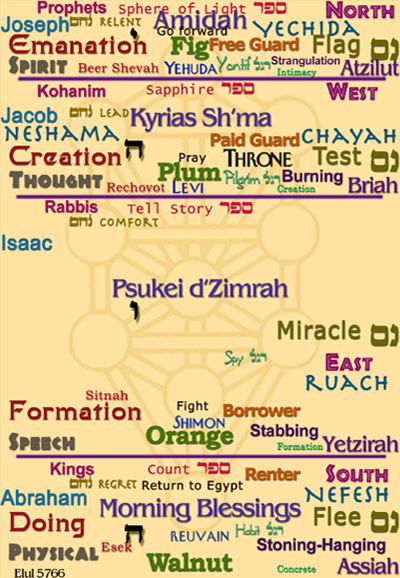
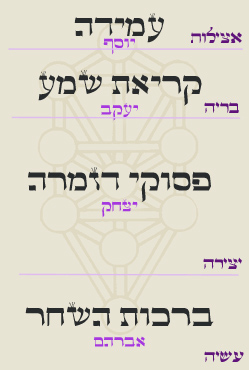
THE TREE OF LIFE
THE FOUR WORLDS


Larger version with English at bottom of page

Hebrew Version


Here are the parshas with the full titles, transcribed by Deborah Miller. The same shiurim are linked below with the Parsha summaries.

Bereshis: The Torah of Self-Contraction
Bereshis II: A Lumpy Universe
Noach: What Happens When the Cheque Stops Coming?
Lech Lecha: Out of the Matrix
VaYeshev: the Creation of Freaks and the Light of Hannukah

An Overview of Genesis: Vayechi – The Art of Coming Closer

VaYeshev: Stone in the Bread vs. Fly in the Wine. ABANDONMENT THEOLOGY
Shemoth: Disillusionment, Catharsis and Finding Life in the Desert
BeShalach: The Torah of Radical Amazement Paradoxes, Provocations, and the Portal to Revelation
Metzorah: Chaos Theory, and the Meaning of Freedom
Achrei Mot: Pilpul and The Torah of Hurt Feelings, and the Art of Surpassing Oneself
Kedoshim: The Torah of the Lowest Common Denominator : Making Things Count
Emor: The Torah of Complaining : An Anatomy of Tuma
B’Har: The Process of Hod, the Whirling Dervish and The Still Small Point
B’Chukotai: The Practice of Dying and the Bedtime Shema
BeHa’alothekha: A reflection on the process of going out and coming back home
Korach: Demons go to Yeshiva: Embracing the negative
Ekev: The Greatest Light
Nitzavim: The Torah of Obligation and the Dance of Reciprocity
Hard Rain and HaAzinu: Singing the Song of the Torah
VeZoth HaBerackha: Sukkot, Wind, Rain and Vulnerable Trust


Bereishis [ daf 2]
[Genesis 1:1 - 6:8:] The world is created in six days. Adam and Eve are expelled from the Garden of Eden, Cain / Abel.

Metzora # [Leviticus 14:1 - 15:33] The laws for the purification of the leper after he has healed are discussed.
Noach [Genesis 6:9 -11:32] A flood destroys the world. HASHEM's rainbow promises that the world will never again be destroyed in its entirety. Acharei Mot #  [Leviticus 16:1 - 18:30] Aaron's sons die. Aaron chooses by lot a goat and a scapegoat.
Lekh Lekha [Genesis 12:1 - 17:27] Abraham leaves Mesopotamia for the Promised Land.Hagar and Ishmael. New names and the promise of a child. Kedoshim [Leviticus 19:1 - 20:27] More laws are set forth, including, "Love your neighbor as yourself."
Vayera [Genesis 18:1 - 22.24] Abraham welcomes three angels into his tent and learns that his wife Sarah will give birth to a son. The Binding of Isaac, the destruction of Sodom. Emor: [Leviticus 21:1 - 24:23] The Torah of Complaining : An Anatomy of Tuma. Festival seasons are described in detail. Pesach, the Omer, Shavuot, Rosh haShana, Yom Kippur, Succot, Shemini Atzeres, Menorah, Showbread
Chayyei Sarah [Genesis 23:1 - 25:18] Abraham purchases the Cave of Machpelah for Sarah's burial. Eliezer finds a suitable wife, Rebecca, for Abraham's son Isaac. Behar Leviticus [25:1 - 26:2] The sabbatical and jubilee years are discussed.
Toledot [Genesis 25:19 - 28: 9] The birth of Esau and Jacob. Isaac blesses Jacob. Behukkotai [Leviticus 26:3 - 27:34] The punishment for rejecting HASHEM's covenant is discussed.
Vayetze #[Genesis 28:10 - 32:3] HASHEM appears to Jacob in a dream. Jacob works 14 years and marries Leah and Rachel. Bamidbar [Numbers 1:1 - 4:20] Description of the Israelites' encampments during their journeys through the desert.
Vayishlach  #[Genesis 32:4 - 36:43] Jacob and Esau reunite after 20 years. Rachel dies and is buried in Bethlehem. Naso [Numbers 4:21 - 7:89] Regulations concerning Nazirites and the threefold priestly benediction.
Vayeshev [daf 2] # [Genesis 37:1-40:23] Joseph's brothers strip him of his coat of many colors and throw him into a pit. BeHa’alothekha # [Numbers 8:1 - 12:10] A reflection on the process of going out and coming back home. Kindling of the menorah. Seventy elders are delegated to serve under Moses.
Miketz [Genesis 41:1 - 44:17] Joseph successfully interprets Pharaoh's dreams. Joseph is appointed viceroy. Shelach Lekha # [Numbers 13:1 - 15:41] Twelve spies are dispatched to survey the land of Canaan, two of the spies return with a positive report.
Vayigash # [Genesis 44:18 - 47:27] Joseph reveals himself to his brothers, who are dumbfounded. Korach # [Numbers 16:1 - 18:32] Demons go to Yeshiva: Embracing the negative. Korach refuses to accept the leadership of Moses and Aaron. He and his assembly are killed by an earthquake.
Vayechi # [Genesis 47:28 - 50:26] Jacob blesses his sons. Joseph dies at the age of 110. Chukkat [Numbers 19:1 - 22:1] The laws regarding the red heifer are enumerated. Moses strikes the rock and water gushes forth.
Shemot [Exodus 1:1 - 6:1] Moses is saved by Pharaoh's daughter. HASHEM appears to Moses at the burning bush. Balak [Numbers 22:2 - 25:9] Balak, king of Moab, sends Bilaam to curse the Israelites. Instead, Bilaam gives his blessing to them.
Va'era [Exodus 6:2 - 9:35] HASHEM brings plagues upon the Egyptians. Pharaoh's heart hardens and he refuses to let the Israelites go. Pinchas [Numbers 25:10 - 30:1] The daughters of Zelophechad arc given their father's inheritance. Moses chooses Joshua as his successor.
Bo  # [Exodus 10:1 - 13:16]   The last three plagues. The mitzvah of Rosh Hodesh; the privilege of  blessing the new months. The Israelites hastily leave Egypt and bake matzah from unleavened dough. Mattot [Numbers 30:2 - 32:42] Moses informs the tribal heads regarding the laws of vowing. The battle with Midian. Kashering utensils. Division of the spoils.Request of Reuven and Gad.
Beshallach  # [Exodus 13:17 - 17:16] The waters of the Red Sea divide to make a path for the Israelites. Sweetening of the waters of Marah. Manna falls from Heaven. Water from the rock. Amalek. Masei [Numbers 33:1 - 36:13] The detailed account of the various way stations on the Israelites' route to the Promised Land. Reference is made to the cities of refuge.
Yitro # [Exodus 18:1 - 20:23] Jethro, Moses' father-in-law, advises him to appoint judges so as to case his burden. Moses receives the Ten Commandments on Mount Sinai. Devarim [Deuteronomy 1:1 - 3:22] Moses explains and interprets the law to the people.
Mishpatim # [Exodus 21:1 - 24:18] Moses instructs the Israelites in the Law. Va'et'chanan [Deuteronomy 3:23 - 7:11] The Ten Commandments are repeated, with slight variations. The cities of refuge are mentioned. The first section of the Shema is begun with, "You shall love the Lord your HASHEM."
Terumah # [Exodus 25:1 - 27:19] The instructions for the tabernacle are given Ekev  # [Deuteronomy 7:12 - 11:25] The Shema continues with the second paragraph, which deals with the theme of reward and punishment.
Tetzaveh # [Exodus 27:20 - 30:10] Aaron and his sons are put in charge of the menorah. The priestly garments are described in great detail. Re'eh [Deuteronomy 11:26 - 16:17] Moses continues his address, telling the people that obedience will bring blessing, whereas disobedience will bring curses. Permitted and forbidden foods. Tithing; forgiving of debts and Jewish bondsmen every 7 years. Pesach, Shavuot, Succot.

Ki Tisa # [Exodus 30:11 - 34:35] Ingredients for the annointment oil and the incense are given. The Israelites build a golden calf -: when Moses sees it he shatters the tablets containing the Ten Commandments. Shoftim # [Deuteronomy 16:18 - 21:9] Moses continues, giving rules for judges, the case of the rebellious elder, choosing a king who must write two copies of the Torah, cities of refuge, preserving boundaries, rules of war, preservation of fruit trees, and unsolved murders.
Vayakhel # [Exodus 35:1 - 38:20] The people bring an array of gifts for the Tabernacle until they are told to stop. Ki Tetze [Deuteronomy 21:9 - 25:19] Moses continues, giving laws intended to strengthen family life and human decency in Israel. Laws pertaining to lost property, the educational responsibility of parents to their children, and kindness to animals.
Pikudei [Exodus 38:21 - 40:38] The cloud of glory covers the completed Tabernacle as the Israelites stand in the distance.

Ki Tavo [Deuteronomy 26:1 - 29:8] Moses continues, giving the laws of tithing and first fruits, blessings and curses for following or not following the commandments.

Vayikra # [Leviticus 1:1 - 5:25] HASHEM reveals the sacrifical laws. Nitzavim [Deuteronomy 29:9 - 30:20] The Torah of Obligation and the Dance of Reciprocity. Moses continues his farewell speech, HASHEM tells the people to "Choose Life."
Tzav # [Leviticus 6:1 - 8:36] Moses anoints Aaron and his sons as priests. Vayelekh [Deuteronomy 31:1 - 30] Joshua is appointed successor to Moses. Moses completes the writing of the Torah.
Shemini [Leviticus 9:1 - 11:47] Laws describing kosher and nonkosher animals are enumerated. Haazinu [Deuteronomy 32:1 - 32:52] The Song of Moses, in which he calls upon heaven and earth to witness HASHEM's dependability. Moses' farewell song, a beatiful poem in which he calls upon heaven and earth to witness HASHEM's dependability.
Tazria [Leviticus 12:1-13:59] Cleanliness and uncleanllness are defined in relation to childbirth and leprosy. Vezot ha Berachah [Deuteronomy 33:1 - 34:12] Moses' final blessing poem and the report of his death on mount Nebo. Joshua becomes the leader of Israel. The quality of Moses' prophecy.


THE TREE OF LIFE
THE FOUR WORLDS

Printed Guide
Hebrew Terms

Note that at the transition points in the service, moving up the tree in the chart above, between the worlds, the Kaddish is recited [when there is a minyan].

Sons of Leah

  • Ruvain - see my pain
  • Shimon - hear my bitterness
  • Levi - accompany me
  • Yehuda - gratitude


Chaverim's notes and writings from learning with Rabbi Hoffman
About the Rabbi's Australia sojourn [June, 2003]
Rabbi Henoch's Teaching
Dancing with the Rabbi
Anyway & Simcha IV - by Yaakov S.
Psychodrama group - David ha Melech's dance


Sacred Fire: Torah from the Years of Fury 1939-1942 by Kalonimus Kalmish Ben Elimelekh, J. Hershy Worch, Deborah Miller, Kalonymos Kalmish, Rabbi Shapira
Publisher: Jason Aronson Publishers
Publish Date: December 2000

Sacred Fire [Amazon.com]

HOME / ABOUT / SCHEDULE / MEDIA / LISTS / PRAYERS / PHOTOS / CONTACT
RABBIHENOCHDOV.COM